
Foundations
Golf Drills at Home for Beginners: Where to Start
Infographic
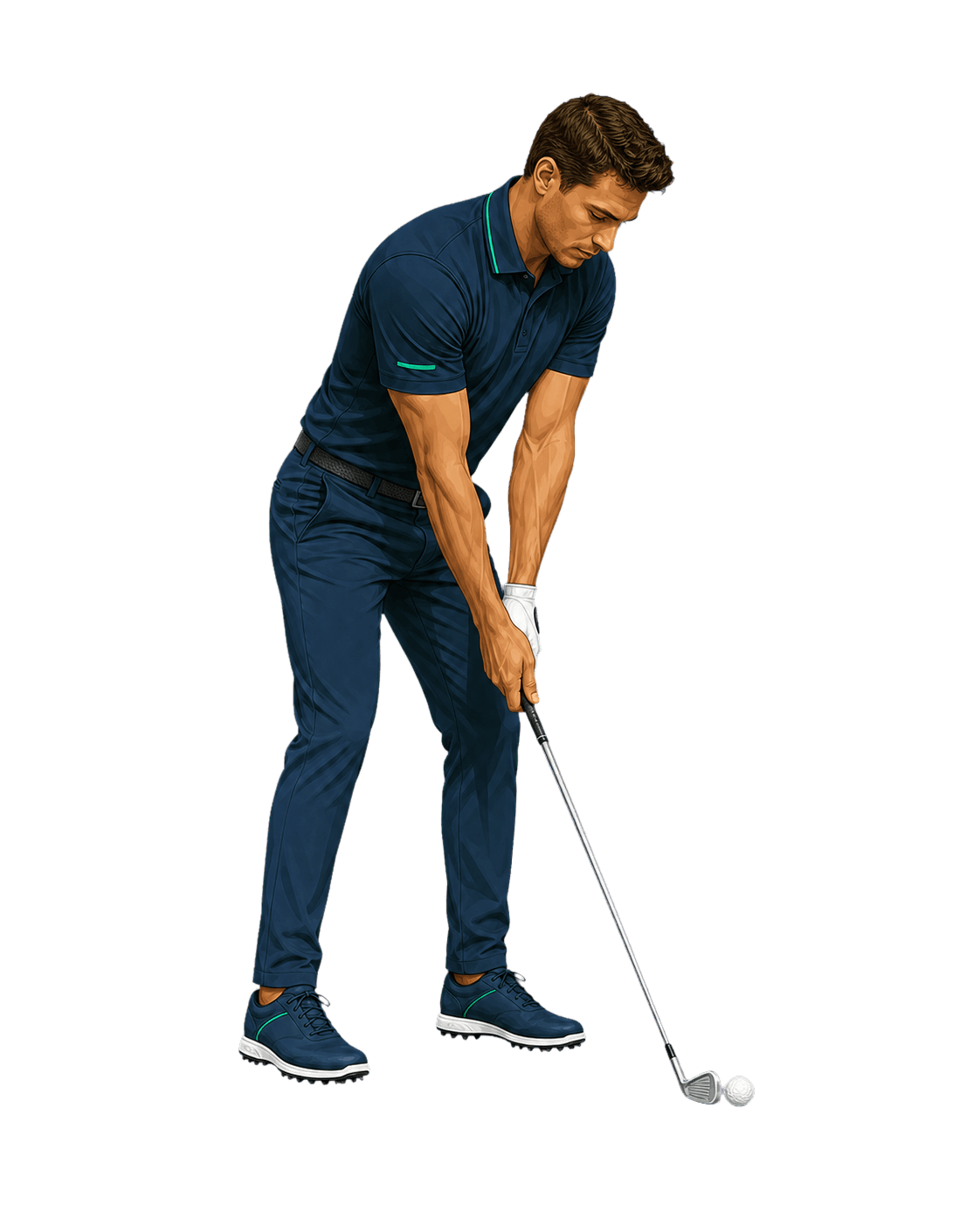
Read the motion
Start Here: What Actually Matters First
For a new golfer, one thing outranks all others: a repeatable starting position and a repeatable rhythm.
The Vocabulary You Need
You need fewer terms than you think. In golf, the ball flight you see is downstream of the clubface and club path at impact, so read those before judging the takeaway or chasing a new tempo.
The First Three Skills, In Order
A consistent setup you can rebuild without thinking, because it makes everything else measurable.
Getting started with golf drills at home does not require you to learn everything at once. It requires three skills in the right order and permission to ignore the rest for now. Here is the beginner's map.
Start Here: What Actually Matters First
For a new golfer, one thing outranks all others: a repeatable starting position and a repeatable rhythm. Repeatability is what turns practice into information, because when every rep starts the same way, differences in outcome start meaning something.
This ordering is not obvious from the outside, because most advice you will meet is written for athletes further along, whose setups stabilized years ago. Advice aimed at their problems lands on your fundamentals like a roof delivered before the walls. Build the walls first; the roof gets easier.
Stop reading — start diagnosing
See if this is actually your swing — free.
Get your top fix, three drills, and a 7-day plan in about a minute. Free to start.
The Vocabulary You Need
You need fewer terms than you think. In golf, the ball flight you see is downstream of the clubface and club path at impact, so read those before judging the takeaway or chasing a new tempo. Learn the handful of words that describe your setup, your contact, and your typical result. Skip the jargon that describes elite technique; you will pick it up naturally if and when it becomes relevant.
Vocabulary earns its place by improving your questions. When you can name what you saw, you can search for it, ask about it, and compare notes on it. A beginner with ten precise words outlearns one with a hundred vague ones.
The First Three Skills, In Order
- A consistent setup you can rebuild without thinking, because it makes everything else measurable.
- Clean contact at comfortable speed, because contact quality drives results far more than power does.
- A simple routine before every rep, because it carries the first two skills from practice into play.
Work them in order. Each one makes the next one learnable: a stable setup makes contact readable, reliable contact makes a routine worth having, and the routine makes both survive the small pressures of playing with other people watching.
What To Ignore For Now
Ignore equipment upgrades, advanced positions from professional slow-motion clips, and any advice that starts with what elite athletes do. Ignore, politely, most tips from well-meaning friends: they describe what worked for their pattern, which is probably not yours yet. You can revisit all of it later from a stable base.
Ignoring is a skill with a shelf life, not a permanent verdict. The parked topics come back one at a time, each invited in by an actual need your video reveals, rather than arriving all at once because an algorithm decided you should worry about them.
Your First Practice Session
Keep it to twenty minutes. Five minutes of setup reps, ten minutes of comfortable-speed contact work with a simple target, five minutes of recording a few reps and noting what repeated. That recording is your baseline, and future you will thank present you for it. When you want structure instead of guesswork, the app runs the same diagnose, one-fix, retest loop this article describes. To have it guide you, start with golf swing analysis, the golf slice fixer, the 7-day golf slice challenge, or a sample golf report.
How To Know You Are Progressing
Progress at this stage is consistency, not highlights: the setup rebuilds itself, the miss pattern narrows, and your typical rep improves even if your best rep does not. Compare this month's video against your baseline instead of trusting memory. Be honest about what a phone video can confirm: it is an estimate with limits, not a lab measurement. Build confidence the boring way, with a retest of the same task under the same conditions. If the pattern creates pain, gets worse with practice, or does not respond after a few focused sessions, work with a qualified coach who can see the full movement. A digital guide can help you structure practice, but it should not replace medical advice, safety judgment, or in-person coaching when those are needed.
FAQ
Am I too new for video analysis?
No. Early video mostly answers simple questions: is my setup repeatable, is contact happening where I think? Those answers are more useful to a beginner than to anyone else.
How much should I work on golf drills at home as a beginner?
Short and frequent beats long and rare. Two or three focused sessions of fifteen to twenty minutes a week, each ending with a tiny retest, builds faster than a weekly marathon.
When should I add the advanced stuff?
When the first three skills stop breaking down under light pressure. Fundamentals are not a phase to rush through; they are the platform everything advanced stands on.
Next Step
Run the twenty-minute first session this week and save the video as your baseline. Everything you add later gets measured against it. One loop, run honestly, beats a month of collected tips.